

How to Bridge Your Child's IEP Accommodations to Your Home Routine

You sit at the kitchen table, looking at two completely different realities.
In your left hand, you have the school’s latest progress report. It says your child is thriving. They are "pleasant," "compliant," and meeting their IEP goals. The school team is smiling, suggesting it’s time to step down from direct Occupational Therapy (OT) to a monthly consultation. They see a stable system.
In your right hand, you are holding the actual reality of your home. You see the illegible handwriting on the worksheets sent home in the backpack. You watch your child short-circuit at the kitchen island because they can't open a package of crackers, button their school pants, or zip up their coat.
Even heavier than the physical tasks is the invisible toll. Your child manages to keep their composure for a few days at school, only to completely shut down or face total burnout by Thursday. They require an entire weekend under low-voltage conditions just to recover enough energy to go back on Monday.
When the school team says, "But they do so well for us," the unspoken, heavy implication hanging in the air is that the breakdown is a parenting failure.
Let’s clear the air right now: Your capacity is a fact, not a flaw. And your child’s exhaustion is a systemic overload, not a behavioral choice. The system is loud, confusing, and siloed by design. When school data doesn’t match home reality, it means the skills and supports are not transferring across the bridge. Here is how we look past the institutional "noise," find the true clinical "signal," and stabilize the circuit between school and home.
The Reality of "High-Load" School Days: Recognizing Masking as a Power Leak
When a child is perfectly behaved at school but completely collapses or faces intense school avoidance at home, the school team often assumes everything is fine. Because there are no loud behavioral outbursts in the classroom, they assume the current IEP accommodations are sufficient.
What they are actually witnessing is masking.
Think of your child’s nervous system like a house running too many heavy appliances on a single, low-amperage circuit. To survive the school day without tripping the main breaker, your child is redirecting every ounce of their processing power into staying compliant, sitting still, and reading social cues.
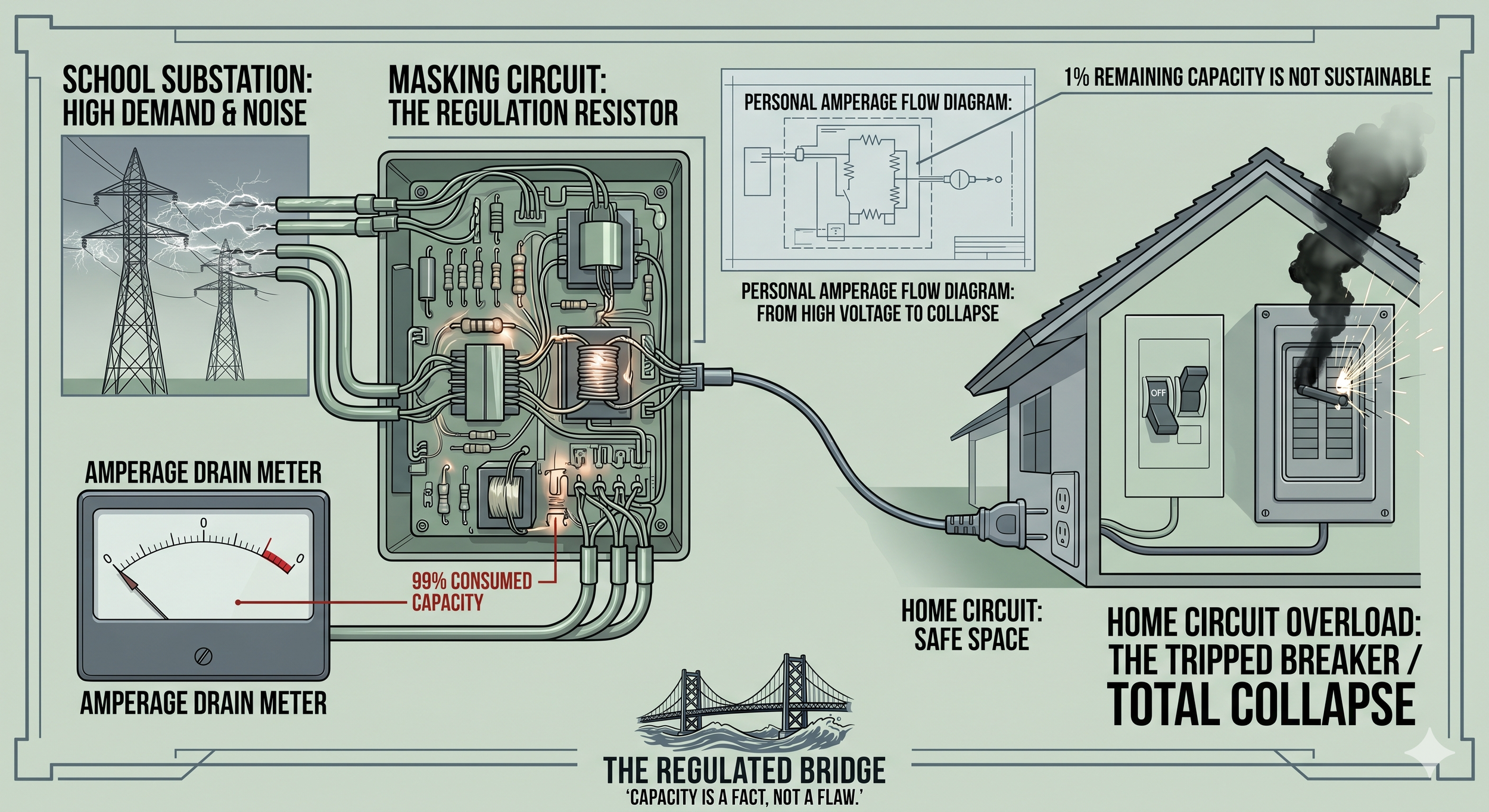
They aren't "fine"—they are running an unsustainably high internal current. By the time they cross the threshold of your front door, their emotional and physical capacity is completely spent. The subsequent shutdown or refusal to go to school isn't a behavior problem; it’s a tripped breaker. They have run out of amperage.
The Strategy: We need to change how we present this to the IEP team. School teams track data that affects the classroom. If the collapse happens at home, it is invisible to them unless you make it visible.
Do not just tell them your child is tired. Document the recovery cost. Keep a simple log for one week:
Tuesday, 4:00 PM: Total sensory shutdown, unable to communicate for 2 hours post-school.
Thursday, 7:30 AM: Severe morning anxiety, somatic complaints (stomach aches), physical resistance to leaving the house.
Presenting the recovery cost shifts the conversation from "He is doing great in class" to "The current school environment requires so much internal energy that it is depleting his baseline capacity for daily living." This proves that additional sensory diets, quiet breaks, or reduced demands are needed during the school day to prevent power leaks.
The Transfer Failure: When "Mastery" at School Doesn't Equal Independence at Home
It is deeply frustrating to be told your child is meeting their fine motor goals when you are still zip-locking their bags and wrestling with their winter coat every single morning.
Why does this gap exist? Schools often measure a skill in a highly structured, sterile environment. A child might successfully manipulate a specialized therapy tool at a quiet desk with an OT sitting directly next to them, prompting them every step of the way. The school records this as "mastery."
But real life is high-amperage. Real life is a chaotic cafeteria with 200 screaming kids, a 15-minute lunch clock ticking down, and a plastic wrapper that requires a specific angle of precision to open. Real life is the hallway transition where 30 kids are moving, and your child has 45 seconds to zip their coat before the bus leaves.
If a skill cannot be performed amidst the sensory noise of daily life, it is not truly mastered.
Flipping the Switch: How to Script Your Response to the IEP Team
When the school proposes cutting back services because they see "success," you do not have to just sit there and take it. You can use structural, data-driven language to advocate for the continuation of services.
Inside our advocacy frameworks, we teach parents to move the team away from vague opinions and force them to look at functional, real-world application. Here is how you can script your response during your next IEP meeting or via email:
The "Functional Transfer" Script
The Opening: "I appreciate the data showing progress within the structured therapy setting. However, our primary goal is the functional transfer of these skills into high-demand, real-world environments."
The Data: "While [Child's Name] may show compliance or success in a one-on-one setting, the skill is not generalizing. At home and during community transitions, she remains completely dependent on adult assistance for basic daily living tasks, including opening food packages, fastening clothing, and producing legible written work."
The Ask: "Before we discuss moving from direct service to a consult model, I need to see data reflecting her independent performance of these skills during chaotic, high-stimulus school routines (like lunch and recess transitions) without direct adult prompting. We need to keep the current level of direct support on the IEP until the bridge between isolated skill acquisition and functional independence is secure."
Why this works: It changes the definition of success. It forces the school team to acknowledge that an accommodation or therapy isn't working unless it actually prepares the child to function independently when the structural safety nets of the therapy room are pulled away.
Lower the Amperage, Raise the Support
If you are currently carrying the heavy weight of a child who is masking at school and collapsing at home, or if you are exhausted from constantly translating school jargon into real-world parenting, please hear this: We aren't trying to fix your child; we are trying to stabilize the circuit.
You cannot force the school system to change its entire infrastructure overnight. But you can protect your home environment, change the way you document the data, and demand that the IEP team look at the total load your child is carrying.
Let’s look at the rest of your daily routine to see where we can clear the table, lower the daily load, and give your family's nervous system some breathing room.
Click below to take our Household Amperage Check to identify exactly where to install the structural supports your home circuit needs right now.
Let’s keep building the bridge.
