

Parenting Burnout vs. Systems Failure: How to Tell the Difference
You are sitting on the bathroom floor, the door locked, staring at the tile. Outside, the house is loud. There is the rhythmic thud of a toy against the wall, the glare of bright overhead kitchen lights that feel like they are piercing your retinas, and the compounding mental stack of an upcoming IEP meeting, an unreturned call to the pharmacy, and dinner that should have been started an hour ago.

You feel a heavy, crushing wave of exhaustion. And right on its heels comes the predictable, toxic whisper: “Why can’t you handle this? Other parents don’t look like they are drowning. You are failing them.”
Let’s flip the switch on that narrative right now.
What you are experiencing isn't "parenting burnout." It isn't a personal flaw, a lack of resilience, or a sign that you aren't trying hard enough. It is a systems failure. We need to stop framing your exhaustion as a personal deficit. Your capacity is a finite resource—a hard fact, not a flaw. When a house has too many heavy appliances running on a single, low-amperage line, the main breaker trips. We don't blame the breaker for doing its job; we acknowledge that the demands placed on the electrical system exceeded its structural limits.
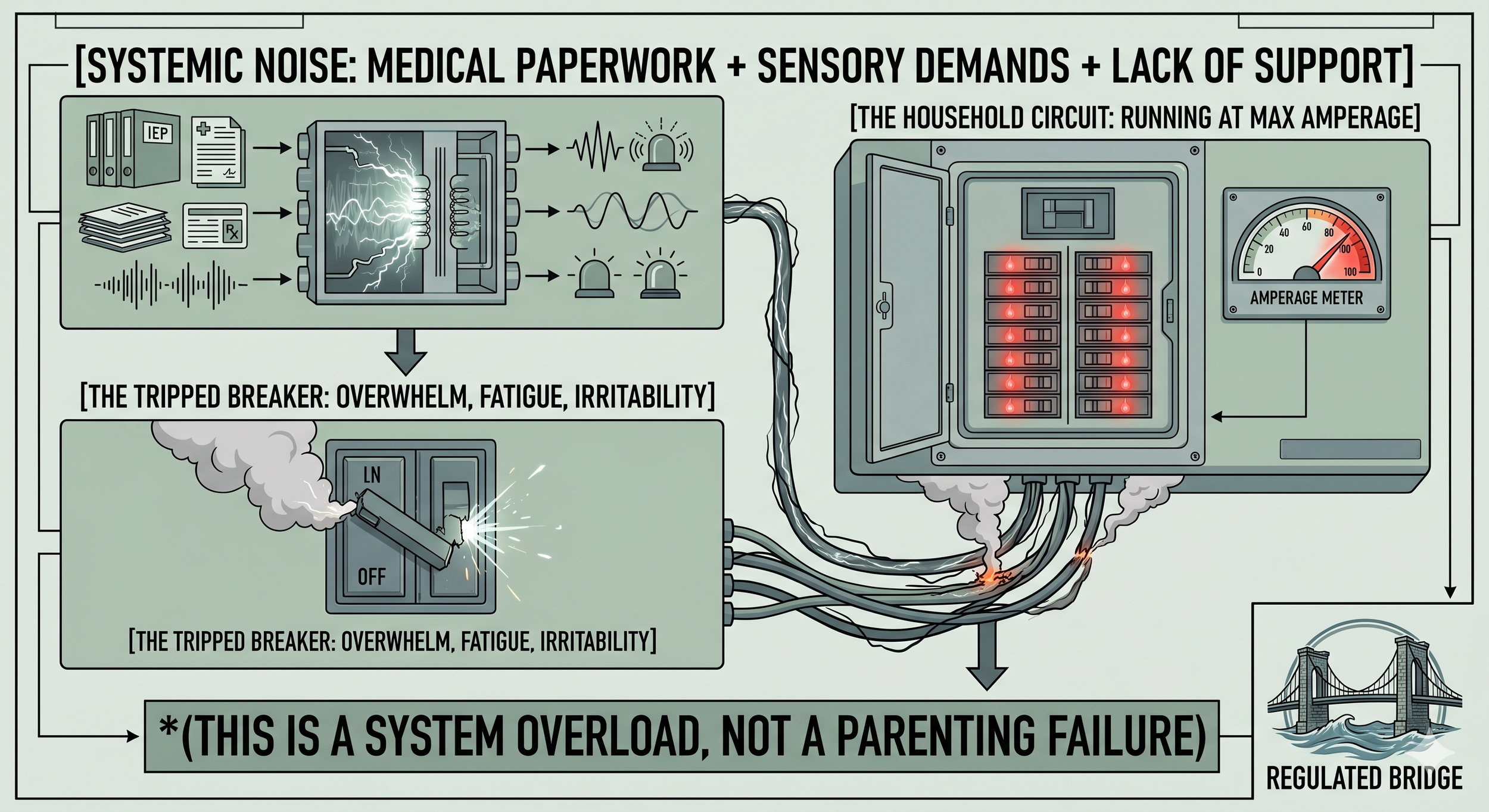
The Myth of the "Empty Cup" and the Trap of Self-Care
We have all heard the well-meaning phrase, "You can't pour from an empty cup." But the mainstream solution offered to parents is almost always toxic positivity wrapped in a spa voucher. You are told to "take a weekend away," "go get a massage," or "just practice self-care."
That advice is completely disconnected from the reality of a high-load household. If you had the clinical support, the trusted childcare, the financial excess, and the time to take a weekend getaway, you would have done it by now. Telling an overextended parent running a high-amperage home to "do self-care" is just adding another task to an already overflowing to-do list. It implies that fixing the systemic overload is your job to figure out in your nonexistent free time.
We aren't going to give you more tasks to manage. We aren't going to tell you to change your mindset. Instead, we are going to look at the immediate environment and install physical surge protectors to lower the voltage before your circuit completely blows.
In-the-Moment Surge Protectors: Protecting Your Internal Circuit
When you are in the thick of the daily surge—whether it’s the 5:00 PM transition or a chaotic morning routine—you cannot leave the room to meditate. You have to survive and lead inside the noise.
Surge protectors don't fix the broken medical or educational systems outside your door, but they do act as a buffer for your nervous system, preventing a total short-circuit. Here are four micro-shifts you can make in the heat of the moment to protect your remaining amperage:
1. Duffle the Auditory Noise (The Volume Dial)
Sensory overload is a massive power leak. When your child is dysregulated, or the environment is chaotic, your nervous system interprets that noise as an actual physical threat. You do not have to absorb the full volume to stay safe and present.
The Surge Protector: Put on a pair of high-quality loop earplugs or noise-canceling headphones. You will still see your child, you can still keep them safe, and you can still hear them—but you are lowering the decibel level. You are putting a regulatory buffer between their chaotic current and your nerve endings.
2. Kill the Overhead "Hospital" Lighting (The Visual Amperage)
Fluorescent or bright overhead lighting sends a continuous, high-frequency "alert" signal to an already stressed brain. If you are already running hot, overhead lights can push you over the edge into task paralysis.
The Surge Protector: Flip off the big overhead switches and turn on a single lamp with warm lighting, or rely on natural light from a window. Lowering the visual stimulation in a room instantly lowers the ambient amperage of the entire environment.
3. Anchor Your Physical System (The Bio-Charge)
When we are running on adrenaline, we stop tracking our basic biological needs. Your brain cannot differentiate between the stress of a clinical dispute and the stress of physical starvation. Low blood sugar directly reduces your nervous system's capacity to handle input.
The Surge Protector: Keep a high-protein, low-effort snack (like a handful of almonds, a meat stick, or a protein bar) stashed out of reach of the kids. Eating something substantial in the middle of a high-stress window anchors your physical system and alerts your brain that you are not in immediate survival danger.
4. The 10-Second Grounding Wire (The Reset)
You don’t need twenty minutes of silence to shift your physiology. You just need to change the physical current running through your body for a brief moment.
The Surge Protector: Press both feet flat onto the floor, lean your back firmly against a solid wall, and take two quick inhales through your nose followed by one long, slow exhale through your mouth. This simple physiological sigh instantly triggers the parasympathetic nervous system, resetting the breaker before a full explosion occurs.
Lower the Amperage, Raise the Support
If you are exhausted today, please stop asking yourself what is wrong with you. Start looking at what is wrong with the load. You are a human being with a finite amount of processing power, operating inside an environment that frequently demands 200% of your baseline capability.
The goal isn't to become a perfect, unflappable parent who never feels overstimulated. The goal is to recognize when your system is reaching its capacity limit, stop the power leaks where you can, and protect your energy with fierce, radical grace.
Let’s look at the structural layout of your daily routine to see where we can permanently clear the table and give your family's nervous system some breathing room.
Click below to take our Household Amperage Check to pinpoint exactly where the power leaks are happening in your home and how to install the permanent infrastructure you need.
Let’s keep building the bridge.
