

The Circuit Board: High-Signal Strategies for High-Amperage Households
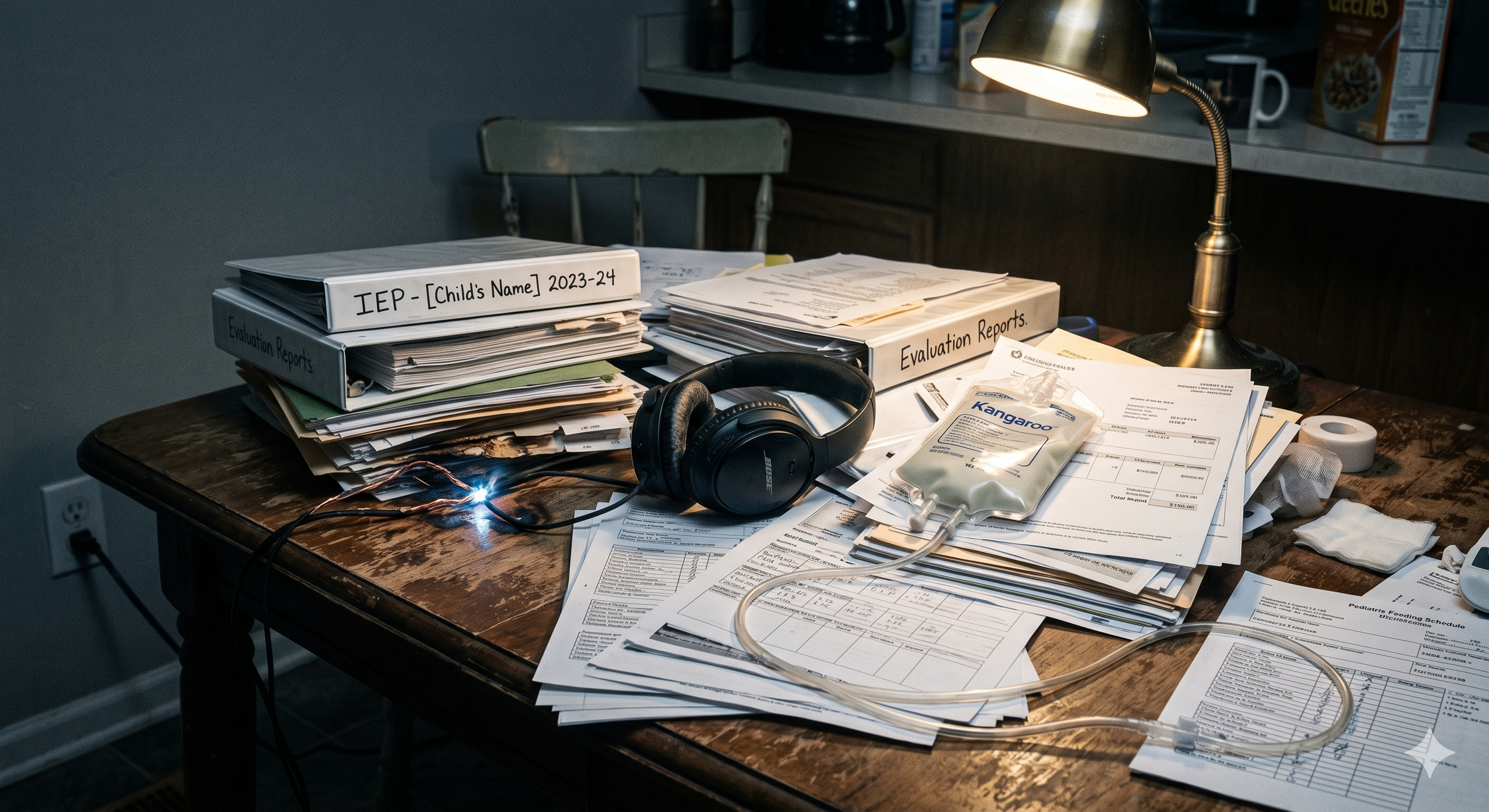
If you have found your way here, your kitchen table is likely disappearing under a mountain of insurance letters, IEP drafts, and medical bills. You are carrying a heavy clinical load, and the last thing you need right now is another generic parenting manual telling you to just "try harder."
Let’s set the record straight before you read a single word: Your low capacity is a functional fact, not a character flaw.
At The Regulated Bridge, we reject "standard" parenting expectations and treat household dysfunction as a systems failure rather than a personal one. We believe that stability is the floor, not the ceiling.
What you will find here: This space is your library of high-signal, low-demand strategies. You will not find arbitrary perfection or judgment here. Instead, you will find clinical blueprints designed to lower your household amperage, such as:
The 5:00 PM Reset: Structural protocols to stop the hardest part of the day from short-circuiting.
Advocacy Script Bags: The exact, copy-and-paste clinical language to bypass insurance denials and navigate IEP meetings.
Capacity-Based Parenting™: Strategies that give you clinical permission to intentionally drop the balls that don't bounce

A Note on Radical Grace
You do not have to read every post. If your internal battery is at 0% (🔋 Drained) today, give yourself permission to close this page and rest.
If you are ready for relief but do not have the capacity to read a full article, stop guessing where your power is leaking. Take our free 4-Question Household Amperage Check to instantly find out which system is draining your capacity today, and my system will automatically deliver the exact micro-win you need.
Stop fighting the surge and start building your bridge.
Professional Integrity & The “Special Needs Tax": Why True Compassion Requires Premium Engineering
Volunteer advocates are a vital part of the special education ecosystem. For many parents, having a compassionate ally sit next to them at a high-stress meeting provides the emotional grounding they need just to get through the door. That level of support is incredibly valuable, and for many families, it is exactly what they need in that moment.
However, there is a distinct difference between having a companion by your side and having an experienced professional completely re-engineer the system.
The Volunteer Advocate: Provides essential presence, emotional validation, and baseline support to help you survive the meeting.
The Systems Engineer: Strips away the educational static, analyzes the clinical data, and builds a sustainable, legally enforceable plan designed to lower the household amperage.
The special education and medical systems are loud, chaotic, and confusing by design. When a child’s plan is missing the correct technical language, it creates a massive high-voltage environment at home. If you need someone to help hold the weight of the moment, a volunteer is a beautiful resource. But if you need to pull the wires apart and rebuild the infrastructure, you need an advanced technical navigator.

What to Do When Your Child's Formula or Medication is on Backorder
When a supplier tells you something is out of stock, a Tier 1 representative is usually just reading a script. They don't have the systemic power to fix it, which means you can waste precious energy trying to negotiate with a dead end. You need to immediately shift the conversation to access the exact data points required to pivot.
Inside our Insurance Fighter Script Bag, we use the "Formula/Medication Backorder" Reset script for exactly this scenario. When you call the supplier or your insurance provider, you aren't asking for a status update—you are initiating an emergency protocol.

How to Bridge Your Child's IEP Accommodations to Your Home Routine
When the school team says, "But they do so well for us," the unspoken, heavy implication hanging in the air is that the breakdown is a parenting failure.
Let’s clear the air right now: Your capacity is a fact, not a flaw. And your child’s exhaustion is a systemic overload, not a behavioral choice. The system is loud, confusing, and siloed by design. When school data doesn’t match home reality, it means the skills and supports are not transferring across the bridge. Here is how we look past the institutional "noise," find the true clinical "signal," and stabilize the circuit between school and home.

Parenting Burnout vs. Systems Failure: How to Tell the Difference
What you are experiencing isn't "parenting burnout." It isn't a personal flaw, a lack of resilience, or a sign that you aren't trying hard enough. It is a systems failure. We need to stop framing your exhaustion as a personal deficit. Your capacity is a finite resource—a hard fact, not a flaw. When a house has too many heavy appliances running on a single, low-amperage line, the main breaker trips. We don't blame the breaker for doing its job; we acknowledge that the demands placed on the electrical system exceeded its structural limits.

The Noise, The Surge, and Why I Built The Regulated Bridge
I was carrying a heavy clinical load that was never meant for a single parent to manage. I didn't need to work harder, and I definitely didn't need another live video appointment on my calendar—I needed an infrastructure that protected my energy.
That realization is why I created The Regulated Bridge™ and our core philosophy of Capacity-Based Parenting. In this space, we reject the "standard" parenting milestones defined by a neurotypical world. Instead, we prioritize intentional planning over arbitrary perfection, focusing on building the "floor"—the minimum viable systems that keep everyone safe and regulated.